Pick wrong and you're looking at wasted money, disappointing UV protection, or a coating that breaks down early in a harsh climate. The global market for graphene car coatings alone was valued at $0.3 billion in 2025, with projections reaching $0.6 billion by 2034 according to a graphene car coatings market report — proof that this isn't a passing trend.
This guide breaks down composition, durability, cost, and real use cases so you can match the right coating to your vehicle, budget, and climate.
Key Takeaways
- Graphene hybrid coatings often carry 5-9+ year warranties, versus ceramic's typical 5-year term
- Both are nanotech-based and hydrophobic, but differ in molecular makeup and durability
- DIY ceramic bottles start around $76; DIY graphene kits run $40-$150
- Your best choice depends on budget, climate exposure, and how long you'll keep the car
Graphene vs Ceramic Coating: Quick Comparison
Cost
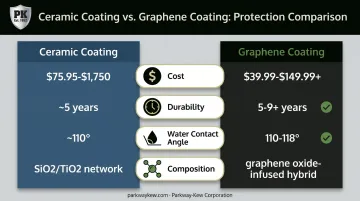
Ceramic coating remains the budget-friendlier entry point. A well-known DIY option, Gtechniq's Crystal Serum Light, starts at $75.95, and professionally installed packages from accredited shops typically run $1,150 to $1,750 depending on prep work and vehicle size.
Graphene products carry a premium:
- DIY sprays and kits generally run $39.99 to $149.99
- The higher price reflects newer chemistry and the added graphene oxide component
- Professional graphene installation pricing isn't standardized publicly yet, so get a shop quote directly
Composition
| Type | Composition |
|---|---|
| Ceramic | Cured SiO2, TiO2, or polysilazane network that bonds and cross-links onto the clear coat, forming a hard protective shell |
| Graphene | Same resin-based network, infused with graphene oxide or reduced graphene oxide (rGO) |
Here's the part most marketing skips: automotive "graphene coating" is almost always a hybrid. It's ceramic chemistry enhanced with carbon particles, not a standalone sheet of pure graphene.
Durability
Manufacturer-published terms tell the clearest story:
| Type | Manufacturer-Cited Durability |
|---|---|
| Ceramic | Roughly 5 years (Gtechniq, Cerakote) |
| Graphene | 5+ to 9+ years for premium tiers, such as Adam's Advanced formula |
These are warranty and claim figures, not independently verified service life. Real-world durability still depends heavily on garaging, wash habits, and climate exposure.
Hydrophobicity & Water Spotting
Both coatings beat wax by a wide margin on water beading. Ceramic topcoats like Gtechniq EXO and CARPRO's Gliss 2.0 land around 110 degrees water contact angle. Graphene hybrids push slightly higher, with Adam's Advanced formula claiming 110 to 118 degrees.
That gap is real but modest. No independent automotive study has measured actual water-spot frequency between the two categories, so treat "less spotting" claims as manufacturer-reported rather than lab-confirmed.
Application & Maintenance
| Type | Application Notes |
|---|---|
| Ceramic | Widely available in 1K consumer sprays and 2K professional systems; more brands and easier sourcing for DIYers |
| Graphene | Similar prep and leveling steps, but carbon particles streak faster if applied unevenly, so experience matters more |
What is Ceramic Coating?
Ceramic coating is a liquid polymer, typically built on SiO2 and TiO2, that cures into a semi-permanent, glass-like layer bonded to your paint. It replaced traditional wax and sealants because it doesn't wash away after a few rain showers or car washes.
The real-world payoff shows up in a few specific ways:
- High gloss that outlasts wax by years, not weeks
- UV resistance that slows paint oxidation and fading
- Chemical resistance against bird droppings, tree sap, and road grime
- Reduced wash frequency, since dirt has a harder time bonding to the surface
Ceramic hardness is commonly benchmarked using pencil hardness ratings, with premium products like Ceramic Pro 9H claiming 9H. This is a pencil test, not a claim that the coating is scratch-proof.
Application methods vary widely too. Single-component (1K) sprays dominate the DIY market for easy home application, while dual-component (2K) systems, applied by trained installers, generally offer thicker builds and longer manufacturer backing.
Ceramic Chemistry Beyond Cars
Ceramic coating technology didn't start in a detailing bay. Plasma-sprayed ceramic coatings have protected heavy industrial equipment against wear and corrosion for decades. Parkway-Kew Corporation, an industrial coating specialist based in North Brunswick, NJ, has applied plasma-sprayed PK-1500 chrome oxide ceramic coatings to wire drawing blocks since the late 1990s — a use case built for high-speed, high-slip ferrous wire drawing. It's a good reminder that ceramic chemistry has already proven itself in far tougher environments than a driveway.
Where Ceramic Coating Fits in Car Care
Ceramic coating typically goes on after paint correction and serves as the long-term protective base, reducing (though not eliminating) the need for regular waxing. It's the dominant choice for:
- Daily drivers where cost matters more than maximum longevity
- Fleet vehicles needing durable, budget-conscious protection
- Detailing shops serving price-sensitive customers
Coated vehicles still need regular washing, but detailing professionals widely report less scrubbing and easier dirt removal, even though no independent study has quantified an exact reduction in wash frequency.
What is Graphene Coating?
Graphene coating enhances the same resin or silazane base with graphene oxide or reduced graphene oxide, layered in to boost mechanical and thermal performance. Pure graphene is a honeycomb lattice of carbon atoms, often cited for intrinsic tensile strength around 130 GPa and thermal conductivity above 3,000 W/mK in industrial testing.
That's genuinely impressive material science. However, those numbers describe lab-grade graphene sheets, not a cured automotive coating with dispersed rGO particles. No manufacturer has published tensile strength or thermal conductivity data for the finished film on your paint.
Real-world benefits still hold up:
- Faster heat dissipation, which helps during hot-climate driving and washing
- Longer-lasting hydrophobic performance compared to standard ceramic
- Reduced washing needs, following the same logic as ceramic but with claimed longer durability windows
Product Variations
- Single-layer DIY graphene sprays for quick maintenance coats
- Dual-layer professional systems for maximum build
- Hybrid graphene-ceramic blends, now the standard format across most brands
Where Graphene Coating Fits Best
Graphene tends to make the most sense for:
- High-value or exotic vehicles where owners want maximum protection
- Extreme climates with intense heat and UV exposure, especially for owners looking to minimize reapplication over several years
Adam's Advanced Graphene Ceramic Coating illustrates the premium end of this category, claiming a 9+ year lifespan with 110 to 118 degree contact angles. Luxury detailing shops and fleet operators in hot regions are increasingly adopting graphene hybrids, though it's still a manufacturer claim rather than an independently measured result.
Graphene vs Ceramic Coating: Which Is Better?
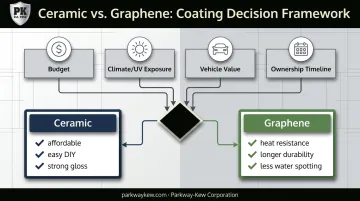
Neither coating wins outright. The right pick comes down to four factors:
- Budget: how much you're willing to spend upfront
- Climate and UV exposure: how brutal your local weather actually is
- Vehicle value: how much protection the car justifies
- Ownership timeline: how long you plan to keep it
Choose ceramic if affordability and easy DIY access matter most, with strong gloss as a bonus. Choose graphene if durability and heat resistance top your list, along with longer-term water-spot prevention, and you're comfortable paying more upfront.
A Common Real-World Scenario
Detailing shops in hot, sun-heavy regions like Arizona and Florida increasingly steer customers toward graphene hybrids after repeated complaints about water spotting on standard ceramic coatings. There's no independently verified before-and-after study quantifying the improvement, but the trend reflects growing confidence in graphene's higher contact-angle claims and longer manufacturer-backed terms.
If you live somewhere hot and sunny with intense UV, lean graphene. If you want an affordable gloss upgrade without overthinking it, ceramic still delivers.
Conclusion
Neither coating is a universal winner. Ceramic remains a proven, cost-effective option for everyday gloss and protection, especially for daily drivers and budget-conscious owners. Graphene suits drivers chasing maximum longevity and resistance to extreme heat, UV, and water spotting, at a higher price point.
What matters most: lower long-term maintenance costs, a better-looking car at resale, and protection that actually matches your climate and driving habits. Match the coating to how you use the car, not just to whichever product has the flashier marketing.
Frequently Asked Questions
Can I wash my car after graphene coating?
Most graphene products need at least 24 hours of indoor curing before any moisture exposure, with a full 5 to 7 days before washing with soap. Use pH-neutral, coating-safe soap and hand-wash methods once cured.
Which coating looks better on a car — graphene or ceramic coating?
Both deliver a similar deep, wet-look gloss. Differences in appearance usually come down to product quality and application skill, not the coating category itself.
How long does graphene coating last?
Typical graphene hybrids advertise 5+ years, with premium tiers like Adam's Advanced claiming up to 9+ years with proper maintenance. These are manufacturer terms, not guaranteed outcomes.
How long does ceramic coating last?
Standard ceramic coatings typically carry a 5-year manufacturer term, though actual longevity depends heavily on product grade, application quality, and upkeep.
Is graphene coating worth the extra cost compared to ceramic?
It depends on your timeline. Graphene's higher upfront price can pay off through fewer reapplications over several years, but if you sell your car within a few years, ceramic may be the more cost-effective choice.
Can you apply ceramic coating over graphene coating, or vice versa?
Layering is possible with compatible product lines from the same manufacturer, but always check the specific product's guidelines first. Mixing unrelated brands risks adhesion problems.